Small Businesses
Prepare routine agreements, supplier contracts, and customer forms for browser-based signing.
Explore small businesses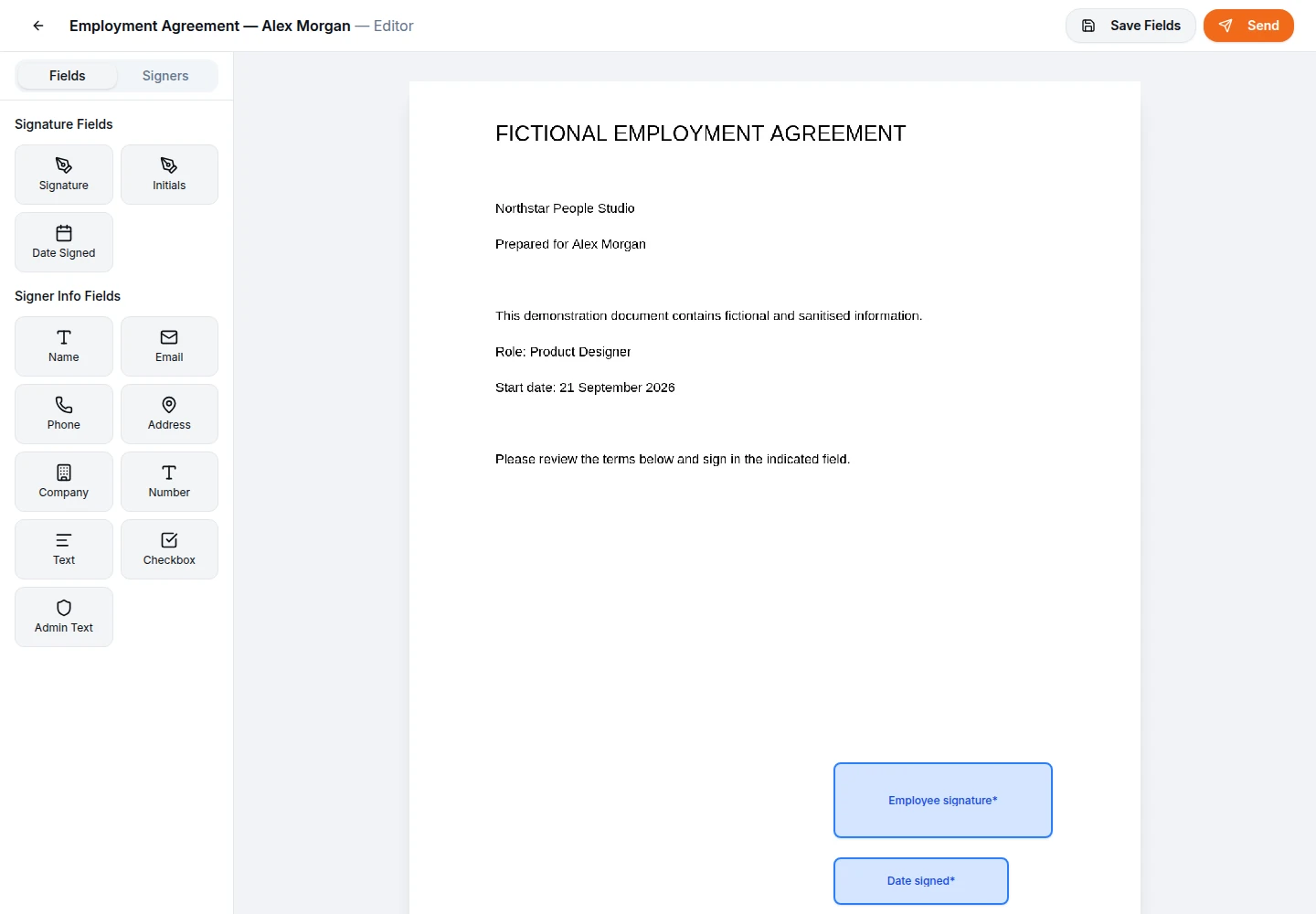


Solutions
Practical document-signing workflows designed to streamline operations and keep your business moving forward.
Prepare routine agreements, supplier contracts, and customer forms for browser-based signing.
Explore small businessesPrepare statements of work, NDAs, and project approvals for client signature.
Explore agencies & consultants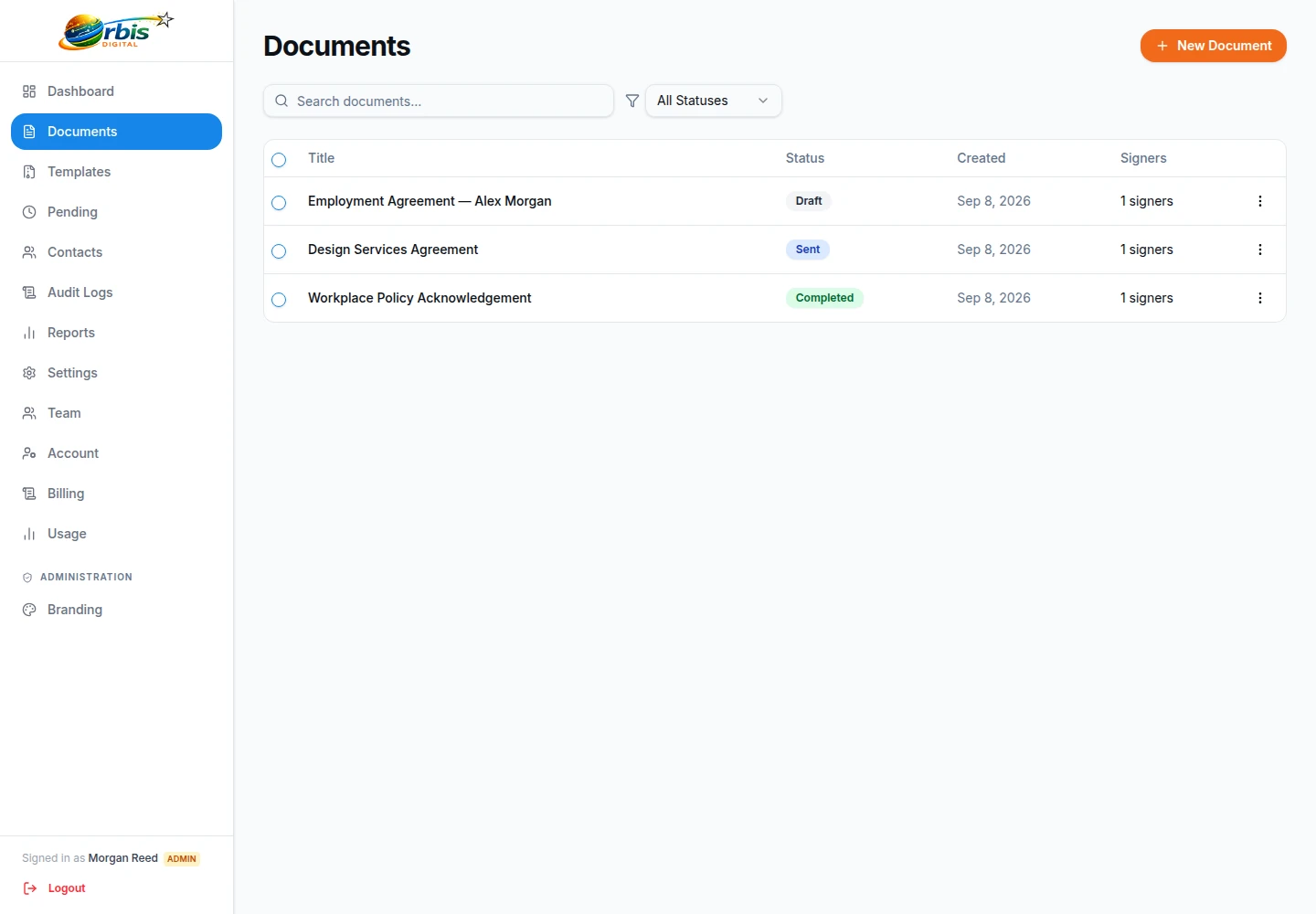
Prepare offer letters and policy acknowledgements for a browser-based signing workflow.
Explore hr & onboarding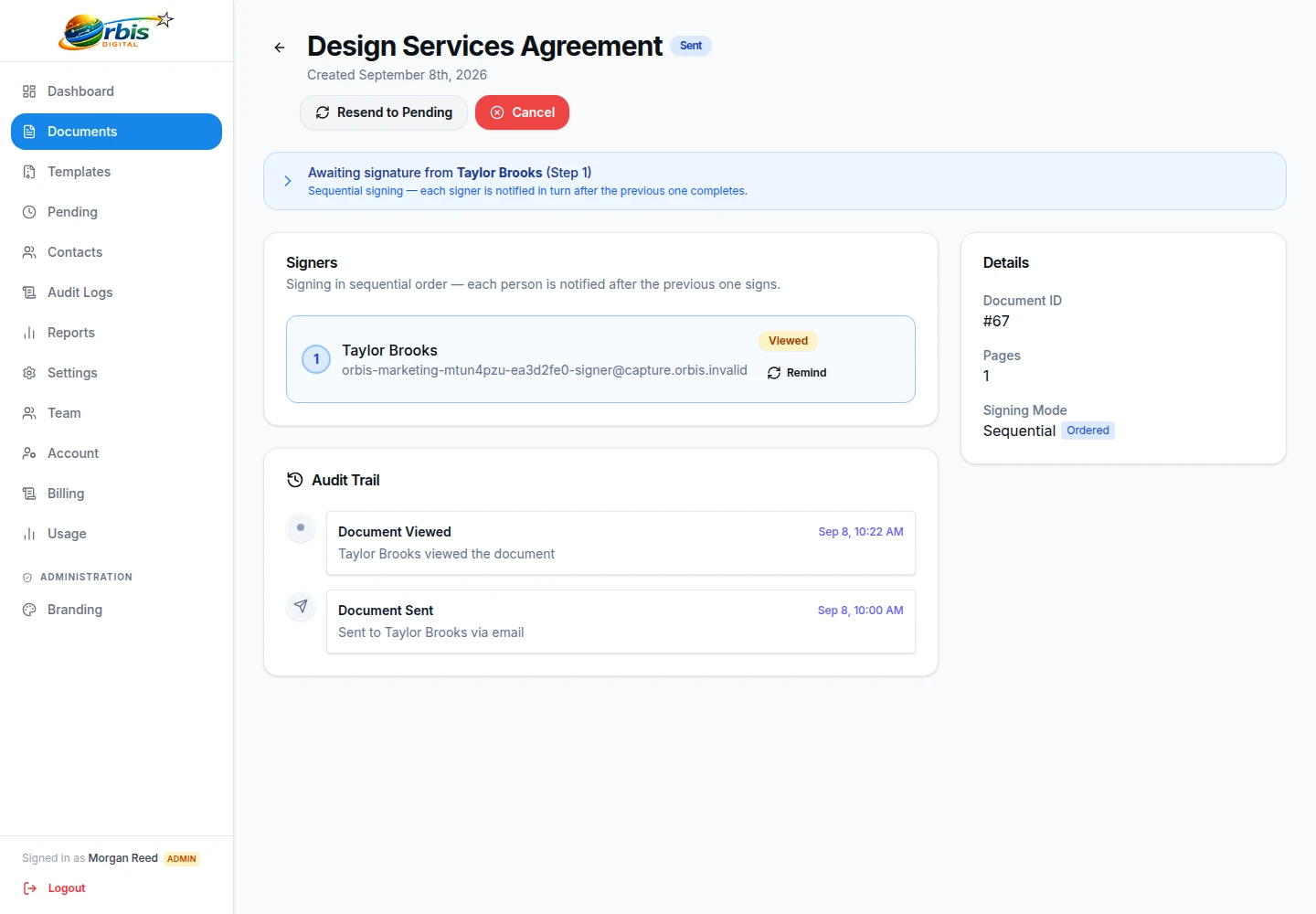
Orbis Sign supports PDF-based signing workflows for many routine business documents. Check any legal, regulatory, witnessing, identity, filing, or contractual requirements before use.
Start free trialDifferent businesses sign different things, but the problems are similar: documents go missing, signatures take too long and nobody is sure where things stand.
Choose your type of business to see which documents people commonly send, and what to check before sending.

Most organisations that look for electronic signature software are not trying to change how they work. They want the agreements they already use to come back signed sooner, without printing, posting or scanning, and with a tidy record of what happened. That is true whether you run a two-person shop, a creative agency or a busy HR team.
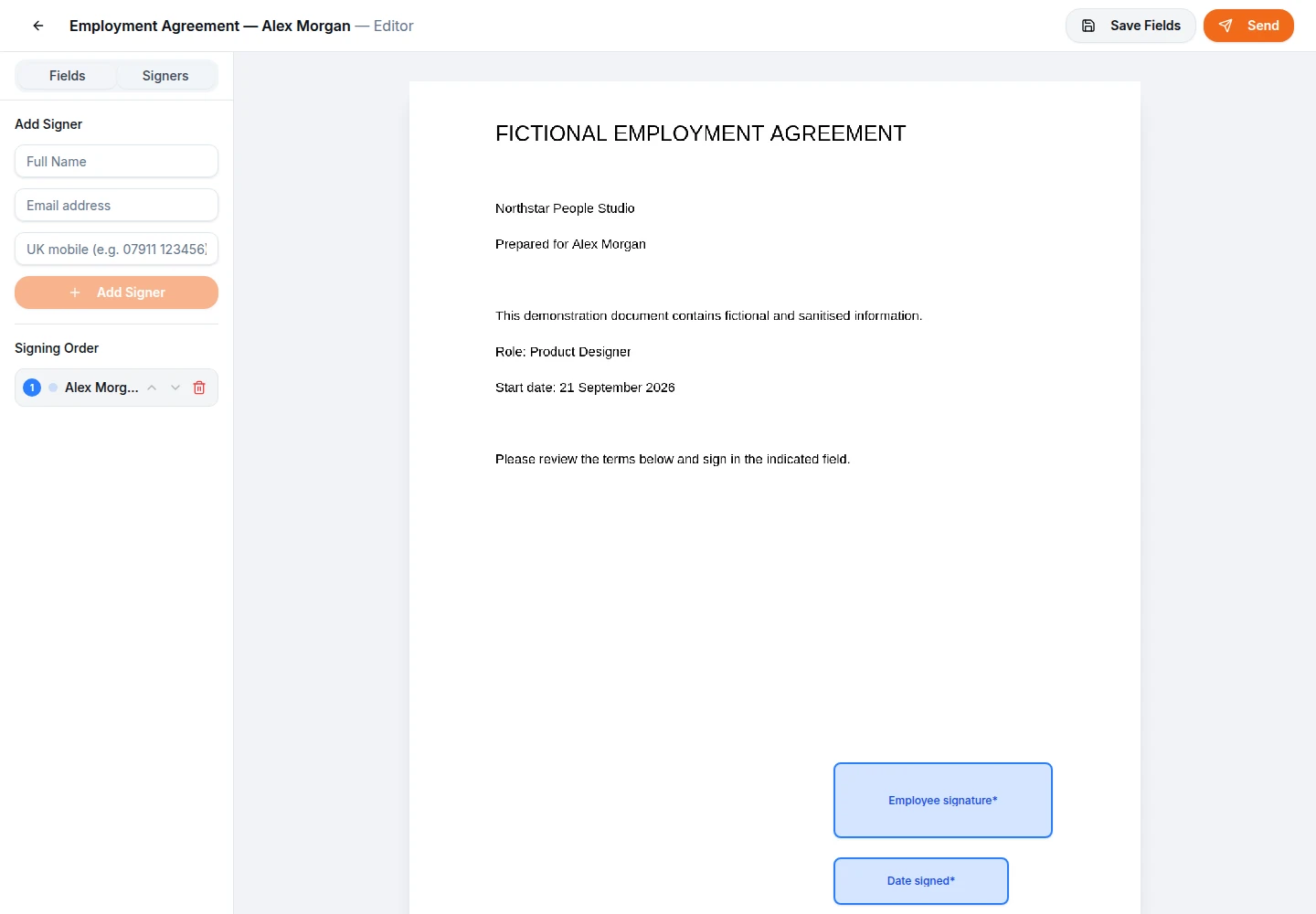
Orbis Sign keeps to that job. You upload a finished PDF, place fields for each signer, choose whether people sign one after another or at the same time, and send. Recipients sign in their browser with no account, and everyone receives the completed PDF and a separate audit certificate by email. The sector pages below explain which documents each type of business tends to send, the checks worth making first, and where electronic signing is not the right route.
Owners of small firms usually handle sales, admin and delivery themselves, so paperwork gets squeezed into evenings. Our page on e-signatures for small businesses looks at the documents that matter most to them: quotes that need accepting before a job is booked, terms of business, supplier agreements and simple customer forms.
It walks through hypothetical examples for a builder, a shop, a cafe and a sole consultant, and explains why a single flat monthly price with no per-user charge suits a business that sends a steady trickle of documents rather than thousands.

Agencies live and die by scope. A statement of work signed before the kick-off meeting protects both sides, and a mutual NDA signed before a pitch lets a prospective client share their brief with confidence. The agencies page covers statements of work, retainers, change requests, NDAs and freelancer agreements.
It also explains how sequential signing lets a client approve first and an agency director countersign afterwards, how templates keep standard wording consistent across account managers, and what clients will and will not see of your brand on the signing page.

For people teams, the aim is to have the paperwork done before a new starter walks through the door. Our HR onboarding page deals with offer letters, employment contracts, policy acknowledgements and contract variations, and with keeping personal information out of places it does not belong.
It is clear about the limits too. Signing an employment contract online does not carry out right-to-work, identity or reference checks, and those remain separate steps in your HR process.

Recruiters juggle two sets of signatures at once: candidates who are often on the move and checking email on a phone, and hiring clients who need to agree terms of business before a placement. The recruitment page looks at candidate registration documents, client terms and the practical side of getting a signature from someone between interviews.
Because signing works in a mobile browser and invitations can also go by text message where SMS is enabled for your workspace, a candidate can usually sign without waiting until they are back at a desk.

Letting agents, property managers and estate agents send a lot of routine paperwork, from terms of business with landlords to tenancy-related forms. The property page explains where electronic signing helps and, just as importantly, where it does not.
Some property and land registry transactions, and deeds that need a witness, carry extra formalities that a general e-signature tool does not meet. That page sets out which kinds of document to check carefully before sending, as general information rather than legal advice.

Accountants, consultants, surveyors and other advisers start most relationships with an engagement letter and a set of onboarding documents. The professional services page covers engagement letters, authorities, annual renewals and the record-keeping that clients and regulators may expect you to have in good order.
It also explains what the Orbis Sign audit certificate records, such as names, email addresses, signing times, IP addresses and a SHA-256 hash of the completed PDF, and why that supports your own records without independently proving who someone is.

Every business on this page uses the same product and the same price: £8.99 a month for up to 500 documents sent for signature, with no charge per user and no overage fees. If you reach the monthly limit, sending simply pauses until the next month. You can try it for seven days without entering a card.
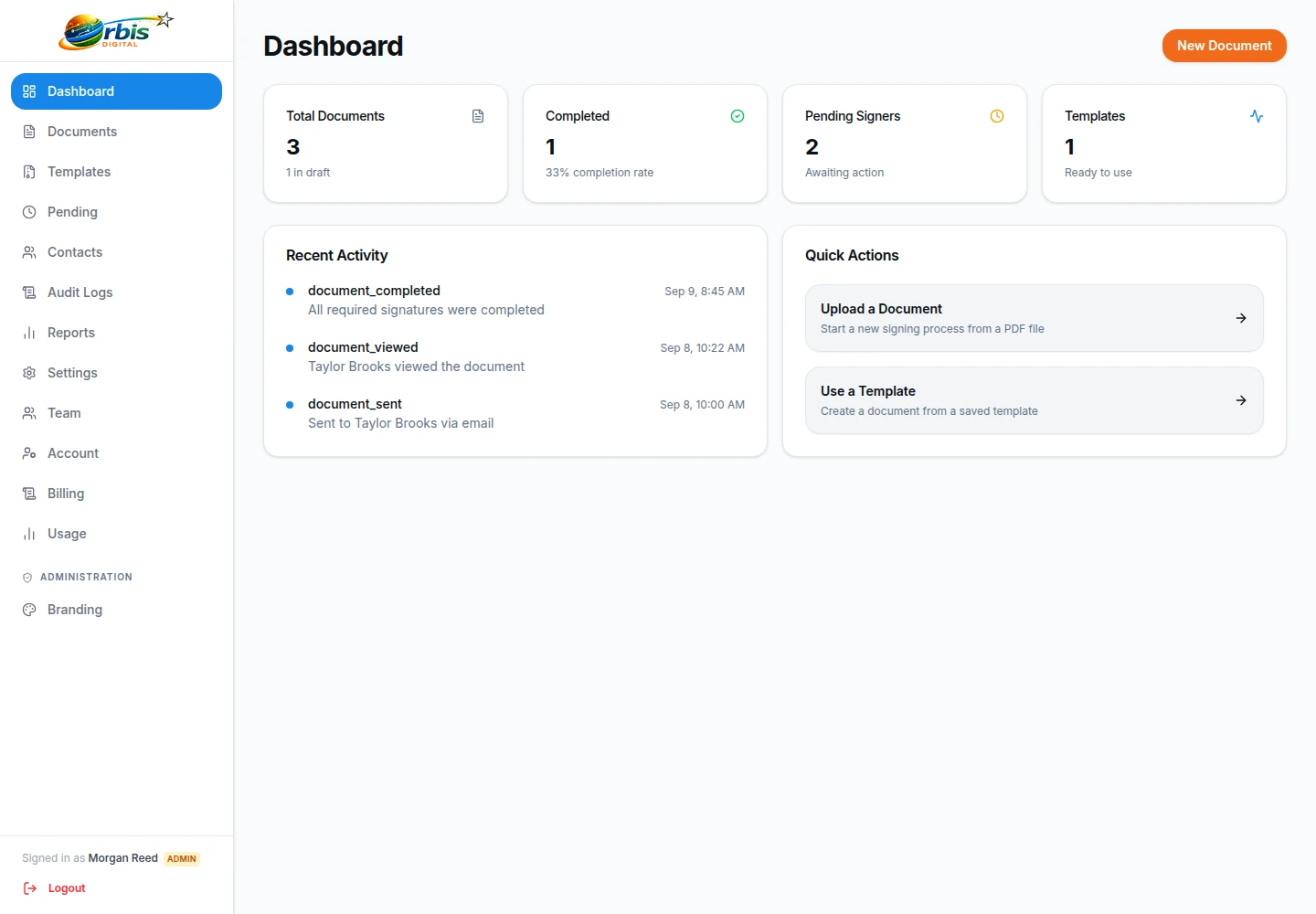
The dashboard gives the same view to everyone, showing documents by status, recent activity and the average time to sign, so a shop owner and an HR manager see the same tools applied to their own documents. The pricing page has the full detail.
Whatever you sign, the same questions come first. Is the PDF the final agreed version? Are the names and email addresses correct? Does the person signing have authority to bind their organisation? Does this type of document need a witness, a deed or a specific filing route?
Electronic signatures are generally capable of being legally valid and admissible in evidence in England and Wales, under the Electronic Communications Act 2000 and the UK version of eIDAS. Orbis Sign provides simple electronic signatures; it does not provide advanced or qualified electronic signatures. Our guide to electronic signatures in the UK explains more. This is general information, not legal advice.

No. Every customer uses the same product on the same plan. The sector pages explain how the existing features suit different kinds of document, such as templates for repeat agreements or sequential signing for countersignature, but they do not describe separate editions or extra modules.
Yes, if your documents are PDFs and are suitable for a simple electronic signature. Charities, clubs, trades and many other organisations send the same kinds of agreement. Check whether any document needs a witness, a deed or a special filing route before you send it, and take advice where it matters.
No. Recipients do not need an Orbis Sign account and are not charged. Each person gets a unique link by email, or by text message where SMS is enabled for your workspace, and signs in their web browser on a phone, tablet or computer.
Orbis Sign runs on servers in France, within the European Economic Area, and is operated by Orbis Digital Ltd, a company registered in England and based in Newcastle upon Tyne. The security page describes the controls in more detail.
Yes. The seven-day free trial needs no card. The most useful test is to upload a real but non-sensitive PDF you send often, place the fields, and send it to yourself or a colleague. That shows you the invitation email, the signing page on a phone and the completed PDF and certificate exactly as your recipients would see them.